


How Does an Activated Carbon Water Filter Work and When Is It Worth Using
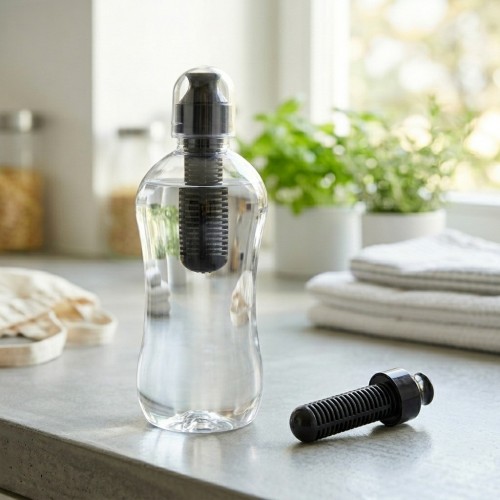
Water is part of our everyday lives – we drink it at home, at work, at the gym, and while travelling. When we use a reusable water bottle, we can easily carry water with us and reduce the need for single-use plastic bottles. But what happens when we add a filter to the bottle?
Water bottles with activated carbon filters are a practical solution for people who want to improve the taste of their water and enjoy a convenient way to stay hydrated throughout the day. They combine a compact design, reusability, and filtration while drinking.
But how does activated carbon work? What substances can it adsorb, when does it make sense to use this type of filter, and how should we maintain it to preserve its effectiveness?
In this article, we will look at the most important things you need to know before choosing a filtered water bottle for everyday use.
What Is Activated Carbon?
Activated carbon is a material with an extremely porous structure that is used in water filters, air purifiers, and various adsorption systems.
It is usually produced from carbon-rich raw materials that undergo specialised treatment. This process creates numerous microscopic pores, significantly increasing the material's surface area.
This structure is what makes activated carbon useful for water filtration.
Unlike ordinary mechanical filtration, in which particles are physically trapped by a barrier, activated carbon works primarily through a process known as adsorption.
What Does Adsorption Mean?
Adsorption is a process in which certain molecules are retained on the surface of a material. In activated carbon, the large internal surface area and porous structure provide numerous sites where certain substances in the water can attach.
When water passes through a suitable activated carbon filter, some of these substances can be retained. As a result, the taste and odour of the water may improve.
It is important to understand that activated carbon does not act equally on all substances. Its effectiveness depends on the type of carbon, the filter design, the contact time with the water, and the characteristics of the specific contaminants.
That is why not all activated carbon filters provide the same level of filtration.
How Does the Activated Carbon Filter in a Filtered Water Bottle Work?
In filtered water bottles, the water passes through the filter immediately before or while drinking, depending on the design of the model.
Water is poured into the bottle and passes through the filter when the bottle is used. The activated carbon comes into contact with the water and can retain some of the substances it is designed to target.
This process allows filtration to take place on the go, without the need for a separate countertop filtration system.
In BottlEco filtered water bottles, the filter is designed for everyday use with tap water. The 550 ml models are compact and can be used at the office, on walks, while travelling, or at the gym.
One of the main advantages is that you do not need to carry a separate container for filtration. The bottle combines water storage and filtration in a single product.
You can explore BottlEco water bottles with activated carbon filters to learn more about the features of the available models.
What Can an Activated Carbon Filter Improve?
One of the best-known applications of activated carbon is improving the taste and odour of water.
Depending on the filter's design and specifications, it may reduce certain unwanted substances that affect the organoleptic properties of water.
1. Reducing Chlorine Taste and Odour
Chlorine is used to disinfect drinking water. In some cases, residual chlorine can give water a characteristic taste or smell that not everyone finds pleasant.
A suitable activated carbon filter can reduce the amount of free chlorine, making the water more pleasant to drink.
This is particularly useful for people who notice a distinctive taste in tap water and prefer beverages with a more neutral flavour.
However, it is important to remember that the results depend on the specific filter and the conditions of use.
2. Reducing Certain Organic Compounds
Activated carbon can adsorb certain organic substances, including compounds that affect the taste and odour of water.
Its effectiveness is not the same for all organic contaminants. It depends on the chemical properties of the substances and the characteristics of the filtration material.
That is why it is important to check exactly which substances a particular filter is designed to remove, rather than assuming that it eliminates all unwanted compounds.
3. Making Water More Pleasant to Drink
When water tastes better, some people find it easier to develop the habit of drinking water regularly throughout the day.
Here, the advantage of a filtered water bottle lies not only in the filter itself but also in its convenience. You can keep it on your desk, carry it in your bag, or take it with you when exercising.
This keeps water within easy reach without the need to keep buying bottled water.
Does Activated Carbon Remove All Contaminants from Water?
This is one of the most important questions to consider when choosing a filtered water bottle.
The short answer is no.
Activated carbon is effective against certain substances, but it is not a universal water purification technology. You should not assume that every bottle with this type of filter can remove all bacteria, viruses, heavy metals, or other potential contaminants.
Different filters have different capabilities. To determine what a particular model can actually remove, you need to check its technical specifications and any available test results.
For example:
-
Chlorine and certain organic compounds: Suitable activated carbon can reduce their levels.
-
Heavy metals: Effectiveness depends on the specific metal and the composition and design of the filter. Not every activated carbon filter reliably removes all heavy metals.
-
Bacteria and viruses: Ordinary activated carbon should not be considered sufficient protection against them.
-
Nitrates and dissolved minerals: Ordinary activated carbon is not designed to reliably remove all such substances.
-
Suspended particles: Their removal depends on the presence and characteristics of any additional filtration layers.
This distinction is important because improving the taste of water does not automatically mean that the water is safe under all conditions.
If the water comes from an untested source, contamination is suspected, or the water has been declared unsafe to drink, do not rely on an ordinary activated carbon water bottle filter to make it safe.
When Does It Make Sense to Use an Activated Carbon Water Bottle?
A filtered water bottle is most useful when it meets a specific everyday need. It is not essential for everyone, but it can be a practical choice in various situations.
At the Office and Workplace
If you spend much of your day at a computer, a reusable water bottle can help you keep water within reach.
If you dislike the taste of tap water, a suitable filter may improve the drinking experience.
In addition, the bottle is easy to carry and can be reused instead of buying water in single-use packaging every day.
While Travelling
When travelling, it is convenient to have your own bottle that you can refill from a suitable source of drinking water.
This is useful on long car journeys, during walks around the city, when visiting different places, or when staying away from home.
An important note: a filtered water bottle does not automatically make water from rivers, lakes, wells, or other untested sources safe to drink. Use it according to the manufacturer's intended purpose and only with suitable water.
At the Gym and During an Active Lifestyle
Having water readily available is convenient during a workout. A 550 ml bottle can be suitable for carrying in a gym bag or backpack.
A filtered model combines several functions in one product and allows you to reuse the same bottle repeatedly.
At Home
A filtered water bottle can also be useful at home, especially if you prefer to carry water with you between rooms or want to keep a personal bottle that you can refill throughout the day.
If your main goal is to improve the taste of tap water, this type of model may be a convenient alternative to a separate filtration system, provided its specifications meet your needs.
How to Choose the Right Filtered Water Bottle
Before buying a bottle with an activated carbon filter, it is worth considering several key features.
1. Intended Use of the Filter
Check what type of water the product is designed for and which substances it can reduce.
If your main goal is to improve the taste and odour of tap water, a suitable activated carbon filter can be a practical solution.
If you have specific water quality requirements, look for technical documentation or test results that confirm the filter's effectiveness against the relevant contaminants.
2. Capacity and Convenience
The bottle's capacity is important for everyday use.
Compact models are convenient for carrying in a bag or backpack or keeping on your desk. When choosing, consider whether you primarily want a bottle for short outings, work, or longer activities.
Also pay attention to the cap, drinking mechanism, and ease of cleaning.
3. Price and Filter Replacement Options
In addition to the price of the bottle itself, consider the cost of replacement filters.
Models with replaceable filters allow you to continue using the bottle without replacing the entire product when the filter reaches the end of its service life.
Before buying, check whether compatible replacement filters are available and what replacement interval is recommended.
How to Maintain an Activated Carbon Filter
Proper maintenance is important both for filtration performance and for the hygiene of the bottle.
Replace the Filter According to the Instructions
Every filter has a defined service life. Over time, adsorption sites can become occupied, and the material's effectiveness may decrease.
For BottlEco bottle filters, the filter can be used for up to 300 uses, or approximately three months with daily use. This is a guideline for this specific product, not a universal rule for all activated carbon filters.
Follow the instructions provided with your model and replace the filter when it reaches the specified limit, even if the water still tastes normal.
You can explore the available BottlEco replacement activated carbon filters for water bottles.
Clean the Bottle Itself Regularly
The filter does not eliminate the need to wash the bottle.
Wash the bottle, cap, and all parts that come into contact with your mouth or the water regularly. If the design allows it, disassemble the individual components according to the manufacturer's instructions to clean hard-to-reach areas thoroughly.
Do not use cleaning products or cleaning methods on the filter unless the manufacturer explicitly permits them.
Do Not Leave the Bottle Dirty for Long Periods
After use, it is a good idea to rinse the bottle and allow it to dry if you will not be using it for a while.
Regular care helps limit the build-up of residue on the internal surfaces and prevent unpleasant odours.
If you notice an unusual smell, a change in taste, or visible contamination, check the condition of the bottle and filter and follow the cleaning and replacement instructions.
Filtered Water Bottle or Ordinary Reusable Water Bottle?
Both options have their advantages. The right choice depends on what you expect from the product.
An ordinary reusable bottle is suitable if you want to carry water with you and do not need additional filtration.
A filtered water bottle offers an extra function: the water passes through a filter designed to improve certain characteristics. This can be useful if you want to reduce the characteristic taste of chlorine in water, provided the specific filter is designed for this purpose.
On the other hand, a filtered model requires additional care and periodic filter replacement.
When choosing, it is therefore worth considering not only the initial price but also how you intend to use the bottle, the maintenance costs, and your actual needs.
A More Sustainable Choice for Everyday Life
Reusable water bottles are a practical way to reduce the consumption of single-use packaging when they are used regularly and for a sufficiently long period.
Filtered models add the convenience of filtration on the go. Instead of carrying a separate container or buying a new bottle every time, you can use the same bottle repeatedly and replace only the filter when necessary.
Of course, the environmental benefits depend on the materials, manufacturing, transport, and length of use. The most sensible choice is a product that meets your needs and that you will genuinely use every day.
If you are looking for a practical solution for work, travel, or exercise, explore BottlEco filtered water bottles and choose a model that suits your daily habits.
Sometimes the most convenient change starts with something very simple – a bottle you can use again and again, and the habit of carrying water with you.
Write a comment